
Visioning and Personal Lifestyle Transformation.
How to Transform your lifestyle through visioning!
Visioning is a statement about an entity’s future state, which could be an individual or a corporate body. The vision itself is a mental picture of a desired future state. It is a significant pillar of the strategic management field. This article intends to guide you in transforming your lifestyle into a sustainable one. This will place an individual in a position capable of beating and winning over the climate crisis.
Visioning Steps
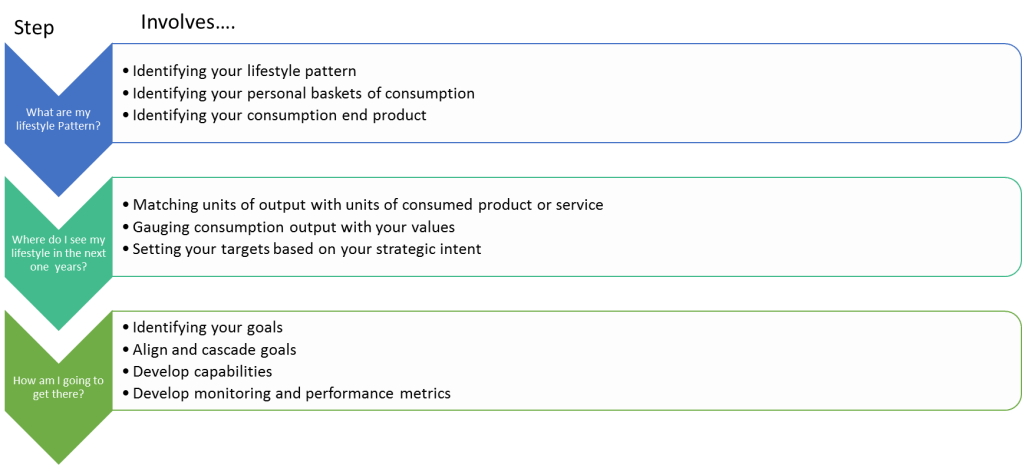
Lifestyle visioning is about capturing your personal aspiration. From the climate action point of view, it is about capturing and positioning yourself strategically into the future, enabling you to control your lifestyle. This covers your carbon emission, its dimensions and your ambitions. It portrays what you value as an eco-friendly individual and how you make choices to realize the desired future. You can kick start the visioning process by asking the following question in three simple steps;
Lifestyle Visioning Wheel
The rationale for questioning in the three-step process, as detailed above, is to enable you to capture your climate and lifestyle ambitions in a precise manner. Our L4F Lifestyle Visioning Wheel capture building blocks for the visioning as shown in the diagram below:

.
The first line of action is to visualize and capture your climate ambition. This could be your desire to reduce emissions or climate warming based on your lifestyle consumption habit and attitude. You may wish to question your household consumption habits with simple questions like what is my consumption style. How is my lifestyle affecting the environment? How many tons of CO2 does my household emit?
The second line of action is to identify your lifestyle pattern. This would enable you to understand different baskets of your household’s consumption. Each basket should be matched with your biospheric and hedonic values.
The third aspect of personal lifestyle visioning is identifying different baskets of your consumption end product. Each output unit should be matched with units of consumed product or service. Then gauge units of consumption output with your values. At the end of this leg, set your targets based on your strategic intent, which reflects your short-term and long-term emission reduction, conservation efforts and contribution to a sustainable future for your generation.
Once that is done, the next thing is to develop specific goals for each basket of emissions, whether it is your food, energy consumption, or emission from your vehicle. These goals are your future state horizon which you can use to position yourself guided by your values.
The next important thing is aggregating similar goals into a family of related goals. This will form what we might call climate action thematic areas. For Instance, you might have a thematic area tagged ‘Sustainable household water consumption. Then you might have goals that support this Thematic area ‘achieve a zero-carbon water source for your household’. Then bring similar objectives that support the realization of that goal. This could be ‘dealing with an environmental-friendly company that produces bottled water and deliver them to your household sustainably’. Another objective could be ‘achieving a rationed level of water usage in your household’, ‘reducing the volume of wastewater in your household’, or ‘achieving a certain percentage of water recycling in your household’, among others.
Assess your personal goals, theme by theme, incorporating essential issues like food, energy, mobility and leisure consumption.
Capability Building in Lifestyle visioning
You now need to critically review your capabilities that can enable you to realize your goals realistically. Bring out the gaps in each basket. It would help if you now dissect these gaps in tandem with actions you need to take to bridge them. What is the nature of these gaps? Are they knowledge, information, networking, or household income gaps? Once you have all the answers, you must devise plans to fill those gaps. If they are knowledge gaps, develop capacity-building strategies for your household. For information gaps, create a networking plan of action or an additional income sourcing plan for your home, as the case may be.
Aligning Your Personal Lifestyle Vision
You need to align your values with your collective or national climate ambitions. This requires you to identify similarities and synergies, which should be cascaded down to your baskets of consumption, behaviour and individual future desired state. Alignment and cascading enable you to develop internal, external and consistency in your visioning. Remember that your national climate commitment and ambitions are aligned with the global climate commitment. You ought to contribute to the national and international climate commitment and ambition.
Now that you have a grand vision attach a timeline for adjusting your lifestyle to fit your goals. And then monitor progress weekly, monthly or quarterly as the case may be.
You may start practising this technique immediately. Act, vision now! Then spread the word and your progress to your friends and family by posting on Twitter, Instagram or any other social media network. Let people know that you care about the planet and that you have your vision to transform your lifestyle for the planet. You could be influencing one or two people, maybe thousands of people!
 Living for the Future